Pop-Up Markets Become One of the Hottest Ways to Build a Brand
Kim Anthony • July 16, 2026

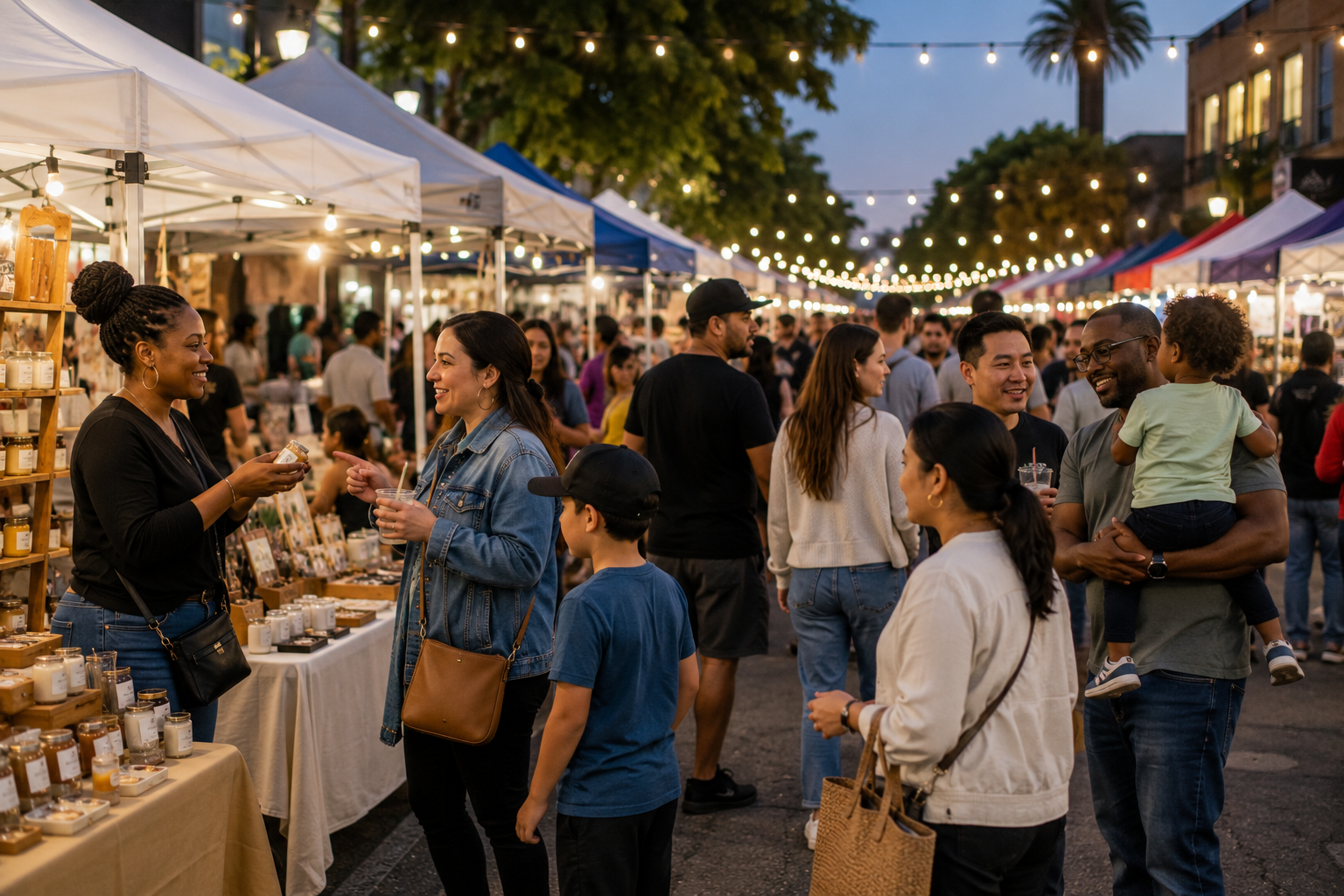
(INLAND EMPIRE) For many small businesses, the next big opportunity isn't opening another storefront. It's setting up a tent. Across Southern California, pop-up markets, artisan fairs, food festivals, maker markets, and community events are becoming powerful platforms for entrepreneurs to introduce their products, build loyal followings, and grow their brands.


From the Ontario Night Market to the Riverside Artswalk, these events are attracting thousands of visitors eager to discover local businesses, handcrafted products, specialty foods, and unique shopping experiences.

For entrepreneurs, that's more than a busy weekend. It's a marketing strategy.


Building Relationships Before Building a Store


For years, launching a retail business often meant signing a long-term lease and investing thousands of dollars before meeting the first customer. Today's entrepreneurs are taking a different path. Pop-up events allow business owners to test products, gather customer feedback, refine pricing, and build brand awareness—often with far less risk than opening a permanent location.


Many successful businesses began with a folding table, a canopy, and a willingness to introduce themselves to the community.


More Than Making Sales


Experienced vendors say the greatest value of a pop-up isn't always what happens at the cash register. It's what happens after the event. Every conversation becomes an opportunity to gain a social media follower, collect an email address, receive customer feedback, or create a repeat customer. For many entrepreneurs, the goal isn't simply selling a candle, T-shirt, pastry, or handcrafted gift. It's creating a customer who returns again and again.


Creating Experiences Customers Remember


Consumers today are increasingly looking for experiences, not just transactions. That's one reason community markets continue to grow in popularity. Visitors enjoy meeting the people behind the products, hearing the stories that inspired a business, watching demonstrations, tasting samples, and supporting local entrepreneurs. That personal connection is something online retailers often struggle to replicate.


A Launchpad for New Businesses


Pop-up events have also become an important entry point for first-time entrepreneurs. Many businesses begin by selling at farmers markets, neighborhood festivals, or arts events before eventually opening retail locations, expanding into wholesale, or launching e-commerce stores.


For entrepreneurs by necessity, the model offers an affordable way to start building revenue while learning what customers truly want.

Why It Matters


The Inland Empire is home to thousands of talented makers, artisans, food entrepreneurs, designers, and small business owners. Community markets give those entrepreneurs visibility they might never achieve through advertising alone. As cities continue investing in placemaking and community events, pop-up markets are becoming more than weekend attractions. They're becoming business incubators.


Make the Most of Your Next Pop-Up Event


Before your next market or festival:

  • Create a simple QR code that links to your website or newsletter.
  • Collect customer email addresses for future promotions.
  • Offer samples or product demonstrations when appropriate.
  • Display your social media handles prominently.
  • Tell the story behind your business—not just what you sell.
  • Take photos and videos throughout the event for future marketing.
  • Invite customers to visit your online store after the event.


Local Events to Explore


Entrepreneurs looking to increase visibility may want to explore opportunities through:

  • Ontario Night Market
  • Riverside Artswalk
  • Local farmers markets throughout Riverside and San Bernardino counties
  • Community festivals and seasonal maker fairs
  • Chambers of Commerce and downtown association events

UBJ Opportunity Take


The most successful entrepreneurs don't wait for customers to find them—they go where customers are already gathering. Pop-up markets offer more than a place to sell products. They provide an opportunity to tell your story, test new ideas, build lasting relationships, and turn first-time shoppers into lifelong customers. In today's marketplace, a single weekend event can spark the beginning of a thriving business.


By Kim Anthony August 18, 2026
The third-generation, Black-owned business has turned a family recipe into a West Coast enterprise—while remaining rooted in the community that helped it grow. By Urban Business Journal Staff For 70 years, the ovens at 27th Street Bakery have produced more than sweet potato pies. They have helped sustain a family legacy, create neighborhood jobs and preserve an important piece of Black business history in South Los Angeles. Located at 2700 South Central Avenue, the third-generation, Black-owned bakery is celebrating seven decades in business—a milestone few small businesses ever reach. Best known for its homemade sweet potato and pecan pies, 27th Street Bakery has grown from a neighborhood favorite into what the company describes as the largest manufacturer of sweet potato pies on the West Coast. From Southern Roots to a Los Angeles Landmark The business began during the 1930s when Harry and Sadie Patterson opened a restaurant along Central Avenue, then the cultural and commercial heart of Black Los Angeles. The Pattersons brought Southern recipes and traditions with them, creating food that offered Los Angeles’ growing Black community a familiar taste of home. In 1956, the family converted the restaurant into a specialty bakery producing sweet potato pies, fruit pies, cakes and other desserts. That transformation established the business now known as 27th Street Bakery. The next generation assumed leadership in 1980, when the founders’ daughter, Alberta Cravin, and grandson, Gregory Spann, took over the operation. Today, the bakery is led by sisters Denise Cravin-Paschal and Olympic gold medalist Jeanette Bolden-Pickens, along with Bolden-Pickens’ husband, Al Pickens. Five additional family members are reportedly involved in the business, continuing a tradition of shared ownership and responsibility. More Than a Bakery The bakery’s longevity is especially significant because of where it stands. Central Avenue was once home to a thriving collection of Black-owned hotels, nightclubs, restaurants and professional offices. As Los Angeles changed and families dispersed into other neighborhoods, many of those businesses disappeared. 27th Street Bakery remained. Its presence represents both economic endurance and cultural preservation. Across several generations, the company has provided employment, stability and a trusted gathering place for neighborhood residents. The bakery has also learned how to grow without abandoning its roots. Customers can still walk into the Central Avenue storefront and purchase fresh pastries, but the company now accepts online orders, offers nationwide shipping through Goldbelly and provides local delivery through services including DoorDash, Uber Eats and Postmates. The company was also selected as an approved supplier for the Super Bowl LVI Business Connect program—an initiative that identified qualified, diverse Los Angeles-area companies to compete for contracting opportunities connected to the event. That combination of tradition, distribution and supplier readiness offers a valuable lesson for other community-based businesses: longevity often depends on preserving what customers love while continually developing new ways to reach them. Seventy Years—and Still Growing In recognition of the anniversary, 27th Street Bakery is offering slices of sweet potato pie for 70 cents on select Saturdays through October 31, according to reporting from LA Local. The promotion is more than an anniversary special. It is an invitation for Los Angeles residents to support a business that has supported its community for generations. At a time when many independent restaurants and neighborhood businesses are struggling with rising costs, changing consumer habits and increased competition, reaching the 70-year mark is an extraordinary achievement. It demonstrates the power of family succession, a trusted product, community loyalty and the willingness to adapt. The Business Lesson The story of 27th Street Bakery offers several practical lessons for entrepreneurs hoping to build companies that last: Build around a signature product. The bakery became widely recognized for one distinctive offering—its homemade sweet potato pie. Protect the brand’s story. Its history and family recipe are not simply sentimental details; they are competitive advantages that distinguish the company from mass-market producers. Prepare the next generation. Leadership has successfully transferred through three generations, allowing the company to preserve family ownership. Expand how customers can buy. Nationwide shipping, online ordering and delivery platforms have taken the bakery beyond the geographic limitations of its storefront. Pursue supplier opportunities. Certification and participation in procurement programs can expose established small businesses to larger contracts and new institutional customers. Remain connected to the community. The company’s enduring relationship with South Los Angeles has created a level of loyalty that advertising alone cannot purchase. For entrepreneurs throughout Los Angeles, the Inland Empire and beyond, 27th Street Bakery is proof that a neighborhood business can preserve its identity, expand its reach and build an enterprise capable of outliving its founders. Seventy years later, the family is still baking—and Los Angeles is still showing up for another slice. Support This Legacy Business 27th Street Bakery 2700 S. Central Avenue Los Angeles, CA 90011 Tuesday–Saturday, 8 a.m.–4 p.m. 323-233-3469 Order or learn more at 27thStreetBakery.com This story was inspired by the CBS Los Angeles report celebrating the bakery’s 70th anniversary . Additional historical information was verified through the 27th Street Bakery , the Los Angeles Conservancy and LA Local .
By Kim Anthony August 18, 2026
Inland Empire companies planning to hire, expand or invest may qualify for tax credits, financing assistance and no-cost guidance from the state. California business owners do not have to navigate growth, permitting, financing and state regulations alone. The Governor’s Office of Business and Economic Development, commonly known as GO-Biz, continues to provide no-cost assistance to companies seeking to start, remain or expand in California. Services include help identifying business incentives, selecting sites, navigating permits, resolving regulatory challenges, accessing international markets and working with state agencies. One of the most immediate opportunities is the California Competes Tax Credit, a competitive income tax credit for businesses that want to locate, remain or grow in the state. GO-Biz is accepting applications for the first 2026–27 funding period through August 10, 2026. Businesses of any size, industry or California location may compete for more than $180 million in available tax credits. Applications are evaluated using factors that include the number of full-time jobs created, the amount of investment proposed and the project’s importance to the state or regional economy. GO-Biz is also offering an application webinar on July 30 from 3 to 4 p.m. Pacific. A recorded webinar, application guide and frequently asked questions are available for businesses that cannot attend. Why This Matters for Inland Empire Businesses The program could be particularly relevant to Inland Empire companies preparing to open another location, increase hiring, purchase equipment, expand manufacturing or make other significant investments. The tax credit is competitive and not every applicant will receive an award. However, smaller businesses should not assume the program is reserved only for large corporations. Eligibility is open to businesses of all sizes, and the economic importance of a project to its region is among the factors considered. For business owners who are not ready to pursue the California Competes Tax Credit, GO-Biz provides access to several other forms of assistance. Its business incentives resources include information about research and development tax credits, funding for employee training, manufacturing-related sales and use tax exemptions, zero-emission vehicle infrastructure incentives and utility discounts for qualifying high-energy businesses. GO-Biz consultants also provide confidential, no-cost assistance to help companies identify relevant tax credits, grants and financing programs. Businesses struggling with licenses, certifications or regulatory requirements can also request assistance. GO-Biz helps companies understand local, state and federal registration processes and identify the permits they may need to start, maintain, relocate or expand their operations. California’s network of Small Business Support Centers provides another entry point. Through the California Office of the Small Business Advocate, entrepreneurs can access no-cost one-on-one consulting and no-cost or low-cost training on business planning, financing, marketing, e-commerce, resiliency and growth. The Orange County Inland Empire Small Business Development Center Network serves entrepreneurs in Riverside and San Bernardino counties. Companies interested in international markets may also explore the California State Trade Expansion Program. Its Export Voucher can reimburse eligible small businesses for up to 75% of pre-approved export promotion expenses, with reimbursement capped at $10,000 per federal fiscal year. Eligible activities may include trade shows, international marketing materials, export-related services and website globalization. What Business Owners Should Do Now Business owners considering the California Competes Tax Credit should begin by documenting their proposed investment, projected hiring, expansion timeline and expected economic impact. They should also: Review the eligibility requirements and application guide. Attend or watch the California Competes webinar. Gather financial, employment and project information before beginning the application. Contact GO-Biz for no-cost guidance. Speak with a local Small Business Development Center advisor for additional assistance. The larger opportunity is not limited to one tax credit. GO-Biz operates as a gateway to state programs that many entrepreneurs may not know exist. For Inland Empire businesses preparing to grow, the first step may be as simple as asking what assistance is available before making the next major investment.
By Kim Anthony August 18, 2026
This is a subtitle for your new post
Show More